
Inside the Insectary: The Team Moving UCMI’s Research Forward
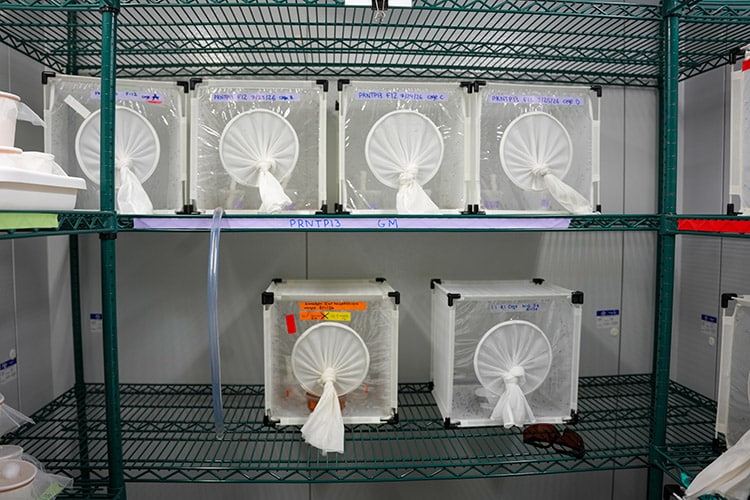 The first thing you notice inside the UCMI insectary at the UC Davis Vector Genetics Laboratory is how much science is packed into a relatively small space.
Green metal shelving lines the walls of temperature-controlled rooms, holding trays, containers and rows of white mesh mosquito cages. Handwritten labels identify strains, generations, dates and experiments underway. Thousands of mosquitoes occupy the cages throughout the insectary, each belonging to a carefully maintained colony with its own history and purpose.
Some of those labels carry names from thousands of miles away: Mali. São Tomé and Príncipe. And, increasingly, Annobón.
The Annobón colonies are among the newest additions to the insectary. They descend from mosquitoes collected on the small Equatorial Guinean island and brought to UC Davis, where the team is now raising and studying successive generations as UCMI’s work with the island moves forward.
But the longer you spend in the insectary, the less the room feels like a collection of mosquito colonies and the more it feels like a team at work.
Ask the insectary team what they do, and Arnold Mbuyata, a student employee studying molecular and medical microbiology, gets right to the heart of it.
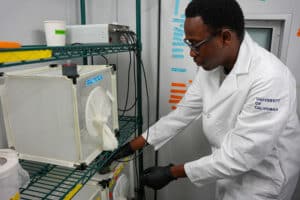 “I take care of mosquitoes,” Arnold said. “I raise mosquitoes and make sure they’re well fed and kept in a condition where they can grow, and then we just study them.”
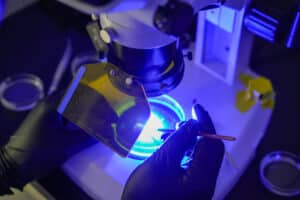
That care and study takes many forms. The team works together to maintain different mosquito strains, raises colonies through successive generations, conducts experiments, collects data, preserves specimens and studies how mosquitoes behave under controlled conditions.
Inside the insectary are both wild-type mosquitoes and modified mosquitoes carrying UCMI’s Gene Drive technology, maintained separately under carefully controlled conditions.
That distinction is central to the research. UCMI’s Gene Drive is designed to spread a genetic modification through a mosquito population that prevents the mosquitoes from transmitting the malaria parasite. In the insectary, the team studies these mosquitoes across generations, evaluating their health, behavior and ability to reproduce as researchers prepare for the technology’s eventual transition from the laboratory to the field.
The work requires precision because the mosquitoes themselves are not always predictable.
Different strains behave differently. Newly established colonies can be particularly fragile. A small change in temperature or humidity can have consequences, and sometimes mosquitoes simply do not behave the way the team expects.
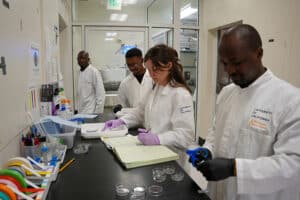 “We’re doing the same things over and over again. It’s very routine at this point,” said Megan Siefker, an insectary assistant. “So, for things to just go wrong, it happens, and we don’t really know why, and that’s frustrating.”
Those unexpected moments are part of maintaining living mosquito colonies. When something changes, the team has to troubleshoot, compare observations and determine what may have happened, all while protecting colonies that can represent generations of work.
As Ivan Mugeni, an insectary assistant, put it simply: “Mosquitoes are mosquitoes.”
That unpredictability is also one reason collaboration matters so much. There are colonies at different stages, experiments running simultaneously and countless details that have to be monitored and recorded. In the tight quarters of the insectary, researchers move around one another tending trays and cages, checking experiments and sharing observations.
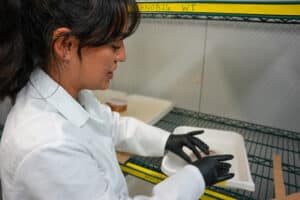
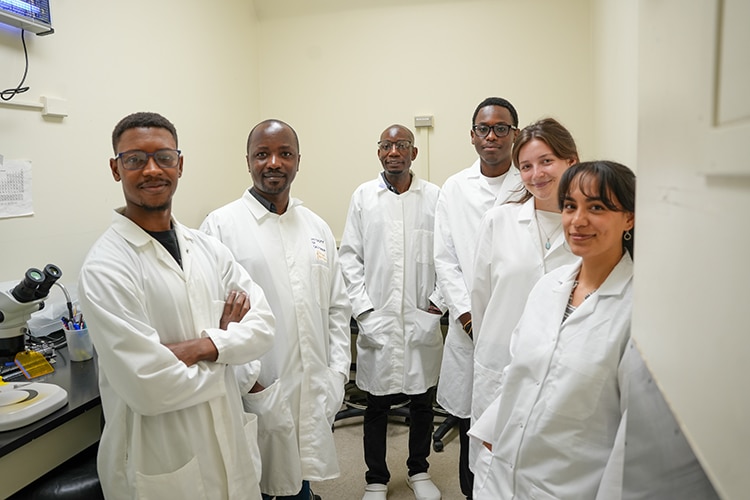
The group brings together backgrounds in biotechnology, molecular biology, medical entomology, mosquito surveillance and vector control. Some members have spent years working with malaria vectors. Others are beginning their careers.
“We all obviously come from very different backgrounds, very different skill sets,” Megan said. “And that works because we’re able to cover each other’s gaps.”
Then she described something that is difficult to miss after spending time with the group.
“We’re all actually friends.”
Someone tending one colony may stop to help with another experiment. Questions are asked openly. People compare observations. And when something goes wrong, responsibility does not seem to stop with whoever happened to be working on that particular cage.
Danspaid Mabuka, an insectary manager, describes it as constant consultation.
“Even if I know, I’ll always ask,” he said. “What do you think?”
That collaboration becomes especially important when the insectary demands attention outside normal working hours. Equipment alarms do not care what time it is. Ivan recalled receiving a call at 11 p.m. because the insectary alarm had gone off.
When that happens, someone has to respond.
“That’s why we are a team,” Danspaid said.
For Some, Malaria Is Personal
The scientific challenge may bring the team together, but their reasons for doing the work are deeply personal and very different.
For Arnold, science had fascinated him since childhood. He remembers reading his father’s science books and being drawn to biology and laboratory work long before joining UCMI first as an intern and later as a student employee.
Ava Pilon, an insectary technician, also remembers an early fascination with the natural world. She was the sibling interested in insects, snakes and spiders. An entomology course in college eventually turned that childhood curiosity into a career direction. But she also wanted her interest in insects to serve a larger purpose.
When she saw the opportunity with UCMI, she found a connection between entomology and a major global health challenge.
“The perfect opportunity to be able to hopefully really help people someday,” Ava said.
For Ivan and Danspaid, malaria is not an abstract public health problem.
Ivan grew up in Uganda, where malaria was part of life. He has experienced the disease himself and began his career working on methods of controlling malaria vectors. The possibility of developing a new approach to malaria elimination gave that work an even deeper purpose.
Danspaid’s connection goes 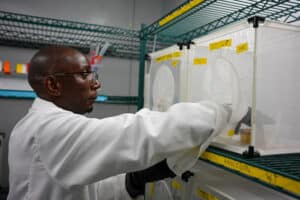 back even further.
He was 12 years old when he lost his sister to malaria.
The loss left him with a question that would ultimately help shape his career: was there something he could do to contribute to the fight against malaria?
He found mentors, pursued medical entomology and has now spent roughly 15 years working in malaria research.
Today, the stakes remain personal. Danspaid has children of his own, and family members living in malaria-endemic areas still experience the disease. He spoke about the financial burden of treatment, but also about something harder to quantify: the emotional stress of watching children repeatedly become sick.
He would like to see something much simpler for the next generation: children playing without their families having to worry about malaria.
That sense of purpose is also familiar to Brian Leetakubuulidde, an insectary technician with a background in biotechnology and malaria-vector research. Growing up in sub-Saharan Africa, he saw malaria as a recurring part of life.
“You’ve probably lost someone, you’ve fell sick so many times. Not once, not twice,” Brian said during the conversation.
For him, the opportunity to work on new approaches to malaria elimination offered a chance to address a problem he had known personally for much of his life.
The possibility of getting closer to that future is what makes the Annobón cages inside the insectary particularly significant.
Ivan recently traveled to Annobón as part of UCMI’s field work to study the island’s mosquito population and collect wild mosquitoes. Reaching them was not always easy.
 “It was very challenging because we had to go to the hard-to-reach places,” Ivan recalled.
The work took him through forests, steep terrain and remote parts of the island as he worked with the field team to understand where mosquitoes were found. Yet Ivan’s strongest recollection was not about the difficult terrain.
“Annobón is a very beautiful island,” he said. “The people are very beautiful.”
Mosquitoes collected during that work eventually made the journey back to UC Davis, where Ivan and the insectary team established colonies from them.
Now the work continues generation by generation.
The team raises the mosquitoes, studies their characteristics and conducts experiments designed to better understand how they behave and perform. The Annobón colonies create a direct connection between the controlled environment of the UC Davis insectary and UCMI’s work thousands of miles away.
For Megan, there is something remarkable about knowing that mosquitoes cared for by this small team could eventually become part of UCMI’s work on Annobón.
The connection between the island and the laboratory is intended to eventually run in both directions, with scientific work continuing in Annobón and members of the team helping support operations there.
For a group accustomed to studying mosquitoes under carefully controlled laboratory conditions, that represents an important transition.
Looking Ahead
Near the end of the conversation, the team was asked what excites them most about what comes next.
Their answers were remarkably consistent.
They want to see whether years of laboratory science can make a difference in the places where malaria continues to affect families.
“We’ve been building these colonies, literally blood, sweat, and tears, running these experiments all in a controlled lab setting,” Megan said. “And now we’re getting to the point where we can watch how it’s actually going to perform in the real world.”
“That’s the moment of truth.”
Ivan described it another way.
“You can see the light at the end of the tunnel,” he said. “I’m really excited and I’m hopeful that malaria will end with our generation.”
Brian expressed a similar hope, imagining a future in which the measure of success is no longer simply controlling malaria, but seeing its consequences disappear.
“I can’t wait to read reports where we have no deaths,” he said. “So many people are going to be saved.”
 Turning that hope into progress requires the careful, sustained work that defines life inside the insectary. Each colony must be raised and monitored across generations. Experiments must be conducted and documented. Changes in mosquito behavior have to be observed, understood and responded to. And when something goes wrong, the team works together to find a way forward.
The technology at the center of UCMI’s work is sophisticated, and its progress depends on the people responsible for carrying that work forward.
After spending time inside the insectary, what stays with you are the people: scientists at different stages of their careers and from different parts of the world, working side by side toward the same goal.
Some came to the work through a lifelong fascination with science and insects. Others came to it carrying memories of malaria in their own families and communities.
What connects them is a shared commitment to advancing research that could help create a future in which fewer families have to experience malaria at all.