From Field Work to Findings: What We Learned in Annobón
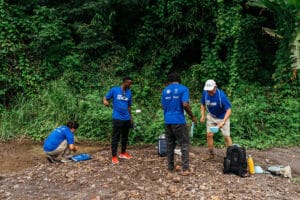 Earlier this year, UCMI researchers traveled to Annobón Island to better understand the mosquitoes that transmit malaria and the environment in which they live.
Working alongside partners and members of the local community, the team collected mosquitoes from locations across the island, surveyed potential mosquito habitats and gathered samples for further study. The goal was to build a clearer picture of Annobón’s malaria-transmitting mosquito population and establish the scientific foundation for UCMI’s future research on the island.
Now, that work is providing important new insights.
One of the clearest findings from the research is also one of the most important: Anopheles coluzzii was the only malaria-transmitting Anopheles mosquito species found during the team’s survey of the island.
Researchers also found that Anopheles coluzzii is present across Annobón, with mosquito populations primarily concentrated around areas where people live.
Together, these findings are helping researchers better understand where malaria-transmitting mosquitoes are found on the island and how their presence relates to the communities around them.
The team’s analysis also provided another important piece of the picture. Mosquitoes collected from different parts of Annobón were found to be genetically similar to one another, giving researchers a better understanding of the island’s mosquito population as a whole.
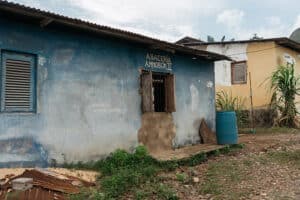 Before developing or evaluating any potential public health approach, researchers first need to understand the local environment.
For UCMI, that means learning as much as possible about the mosquitoes already living on Annobón: where they are found, how populations across the island are related and how they interact with the environment around them.
This baseline knowledge gives researchers a stronger scientific foundation as UCMI continues its work on the island. It can help inform how future studies are designed and allow researchers to evaluate new findings against a clearer understanding of Annobón’s existing mosquito population.
Alongside this entomological work, UCMI partners at MCD Global Health conducted an epidemiological survey to establish a baseline understanding of malaria on Annobón. Supported by UCMI, the survey provides another important source of information to help guide future research and malaria control efforts on the island.
Together, these efforts reflect UCMI’s broader approach to developing new tools for malaria elimination: moving deliberately, building evidence step by step and grounding the science in the communities and environments where the work may ultimately have an impact.